Author: Dublin Property Research Desk

  • Dublin New Build Launches — 09 Sep 2026

    Dublin New Build Launches — 09 Sep 2026

    New residential launches and phase releases spotted across Dublin portals this week.

    1. Dublin City Council Announces Launch of 95 Starter Homes for Sale at Oscar Traynor Woods | Dublin City Council

    Dublin City Council today announced that eligible applicants will be able to apply from 23 September 2026 for the next and final launch of 95 Starter Homes for sale (formerly the L

    🔗 https://www.dublincity.ie/news/dublin-city-council-announces-launch-95-starter-homes-sale-oscar-traynor-woods

    2. Land Development Agency to deliver 253 new homes in Dublin

    🏘️Over 210 homes officially open in Dublin 15 80 cost rental homes launched in Church Fields East, Dublin 15 last Thursday by Minister Kieran

    🔗 https://www.facebook.com/DeptHLGH/posts/250-new-homes-at-park-west-dublin-%EF%B8%8Fthe-the-land-development-agency-has-today-ann/1294965762823769

    3. New Homes – Savills Live

    2, 3 & 4 Bedroom Houses Swords, Co. Dublin POA View now Launching Soon New Phase Available Now More Info Coming Soon #### Old Church 2, 3 & 4 Bedroom Homes Shankill, Co. Dublin POA

    🔗 https://virtual.savills.ie/new-homes

    4. Today saw 290 new homes officially opened in Citywest … – Facebook

    These new homes at Cherry Orchard are being delivered by The Land Development Agency (LDA) and Dublin City Council (DCC). Phase 1 of the

    🔗 https://www.facebook.com/governmentofireland/posts/today-saw-290-new-homes-officially-opened-in-citywestthe-carrigmore-woods-develo/1230735529097318

    5. 3-Bedroom House – The Dodder, Aderrig, Adamstown, Lucan, Co. Dublin – Sherry FitzGerald New Homes – 4839023 – MyHome.ie Residential

    Title: 3-Bedroom House – The Dodder, Aderrig, Adamstown, Lucan, Co. Dublin – Sherry FitzGerald New Homes – 4839023 – MyHome.ie Residential Home Ireland Dublin Dublin County Adamsto

    🔗 https://www.myhome.ie/residential/brochure/3-bedroom-house-the-dodder-aderrig-adamstown-lucan-co-dublin/4839023

    6. Home – Seven Mills

    ## A town that’s full of life and made for living Seven Mills will feature all the amenities you would expect, and the town is the perfect choice for anyone buying a new home in Du

    🔗 https://sevenmills.com

    7. New home developments launching soon – MyHome.ie

    With that In mind, MyHome decided to take a look at five new home developments launching soon that you can now register your interest in. Check them out below… ### Kilternan Villag

    🔗 https://news.myhome.ie/myhome-living/new-home-developments-launching-soon-34110

    8. 104 New Homes for Sale in Dublin Commuter Towns, Dublin – Daft.ie

    104 new homes in developments in Dublin Commuter Towns, Kildare New Release – Phase 2 (Block C) now selling from plans, Phase 3 (Block C) Show Units now

    🔗 https://www.daft.ie/new-homes-for-sale/dublin-commuter-towns-dublin

    9. 2 Bed Apartment – Larger, Oscar Traynor Woods, Coolock, Co. Dublin

    Final Phase Launching August 2026 Register Now. 2 Bed Apartment – Larger Oscar Traynor Woods is a modern residential development, planned as a

    🔗 https://www.daft.ie/new-home-for-sale/2-bed-apartment-larger-oscar-traynor-woods-coolock-co-dublin/6652408

    10. New Apartments for Sale in Dublin Commuter Towns, Dublin | Daft.ie

    40 New Apartments for sale on Daft.ie now. New Release – Phase 2 (Block C) now selling from plans, available for viewing! Detached Homes Launching 29th August

    🔗 https://www.daft.ie/new-homes-for-sale/dublin-commuter-towns-dublin/apartments

    11. New Apartments for Sale in Ireland | Daft.ie

    From €965,000 Logo Oak Church Negotiator Image Oak Church, Kildare, Co. Kildare Oak Church, Kildare, Co. Kildare Outstanding Development New Homes €310,000 Logo Avenlea Negotiator

    🔗 https://www.daft.ie/new-homes-for-sale/ireland/apartments

    12. New Homes for Sale in West Co. Dublin, Dublin | Daft.ie

    Mason Cross, Newcastle, Co. Dublin From €520,000 New Homes €520,000 Logo Heron’s Lock Negotiator Image Heron’s Lock Development, Lucan, Co.Dublin LUCAN Heron’s Lock Development, Lu

    🔗 https://www.daft.ie/new-homes-for-sale/west-co-dublin-dublin

    _Portals: Daft.ie, MyHome.ie. Verify launch dates, phase availability and BER before inquiry._

  • Dublin Auctions & Repossessions Digest — 08 Sep 2026

    Dublin Auctions & Repossessions Digest — 08 Sep 2026

    Dublin property auctions, receiver sales and bank repossessions currently on the watchlist.

    1. Unknown: 278 Glasnevin Avenue, Dublin 11, Dublin – BidX1 Ireland Ltd … — €360,000 (MyHome.ie)

    🔗 https://www.daft.ie/commercial-property-for-rent/278-glasnevin-avenue-glasnevin-dublin-11-co-dublin/6625787

    2. Unknown: Property for auction in Dublin West, Dublin — €400,000 (MyHome.ie)

    🔗 https://www.myhome.ie/residential/auctions/dublin/auction-property-for-sale-in-dublin-west

    3. Unknown: Property for auction in Ireland — €340,000 (MyHome.ie)

    🔗 https://www.myhome.ie/residential/auctions/ireland/auction-property-for-sale

    4. Unknown: Property for auction in Dublin — €490,000 (MyHome.ie)

    🔗 https://www.myhome.ie/residential/auctions/dublin/auction-property-for-sale

    5. Unknown: 36 Tayleurs Point, Rush, Co. Dublin – BidX1 Ireland Ltd – 4989211 – MyHome.ie Residential — €520,000 (MyHome.ie)

    🔗 https://www.myhome.ie/residential/brochure/36-tayleurs-point-rush-co-dublin/4989211

    6. Apartment: Apartment 106 Neptune House, Bellevue, Dublin 8, Islandbridge – BidX1 Ireland Ltd – 4981989 – MyHome.ie Residential — €395,000 (MyHome.ie)

    🔗 https://myhome.ie/residential/brochure/apartment-106-neptune-house-bellevue-dublin-8-islandbridge/4981989

    7. Unknown: 39 Maxwell Street, Dublin 8, Dublin – BidX1 Ireland Ltd – 4995410 – MyHome.ie Residential — €495,000 (MyHome.ie)

    🔗 https://www.myhome.ie/residential/brochure/39-maxwell-street-dublin-8-dublin/4995410

    8. Unknown: 44 Harelawn Drive, Irishtown, Dublin 22, Dublin – BidX1 Ireland Ltd – 4987180 – MyHome.ie Residential — €400,000 (MyHome.ie)

    🔗 https://www.myhome.ie/residential/brochure/44-harelawn-drive-irishtown-dublin-22-dublin/4987180

    9. House: 39 Hollyville Lawn, Palmerston Upper, Dublin 20, Dublin – BidX1 Ireland Ltd – 4994523 – MyHome.ie Residential — €465,000 (MyHome.ie)

    🔗 https://www.myhome.ie/residential/brochure/39-hollyville-lawn-palmerston-upper-dublin-20-dublin/4994523

    _BidX1, Wilsons Auctions, receiver and lender-possession sales. Due diligence required — auction purchases are binding._

  • Dublin Rental Yield Tracker — September 2026

    Dublin Rental Yield Tracker — September 2026

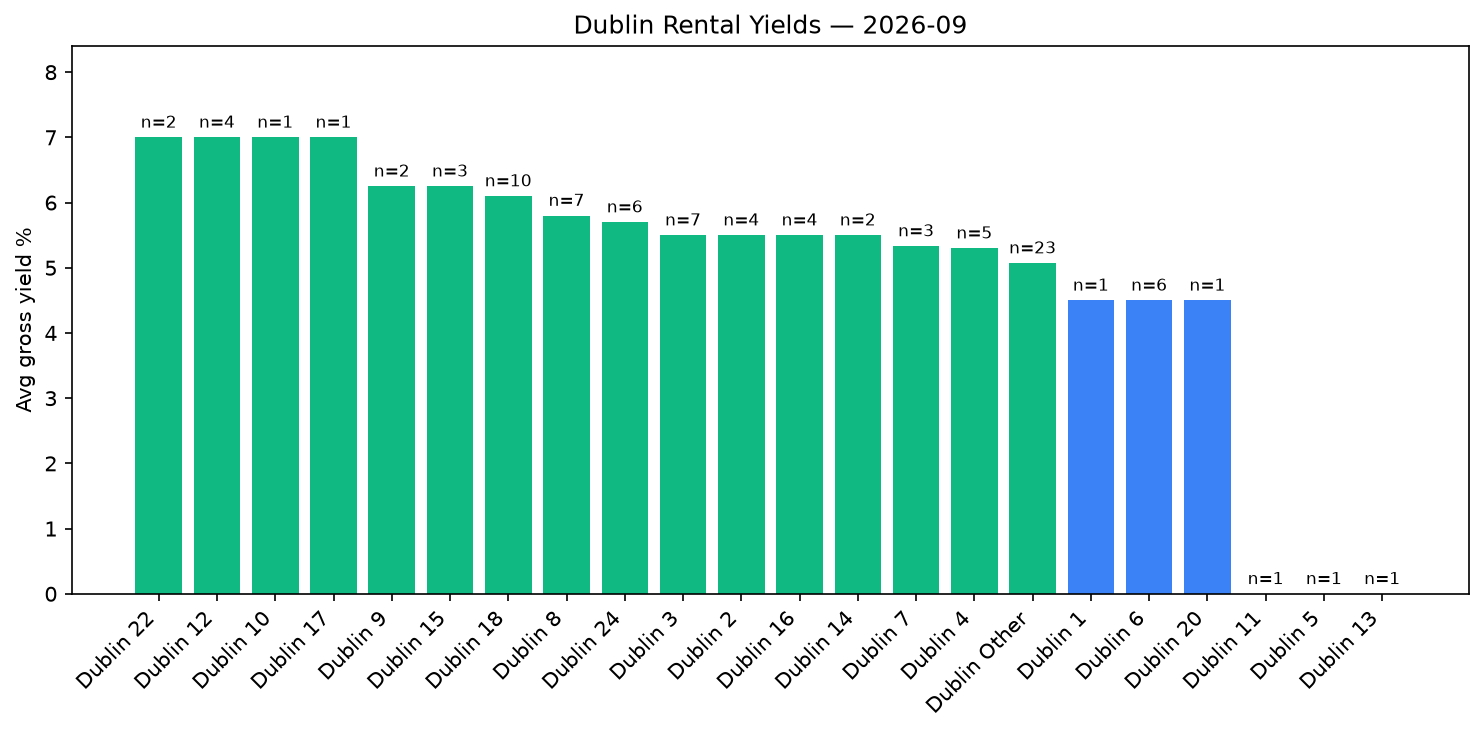
    Dublin rental yields 2026-09

    Average gross rental yields across the Dublin watchlist as of 2026-09.

    • Dublin 22 — avg yield 7.0% (2 listings, avg asking €525,000)
    • Dublin 12 — avg yield 7.0% (4 listings, avg asking €360,000)
    • Dublin 10 — avg yield 7.0% (1 listings, avg asking €695,000)
    • Dublin 17 — avg yield 7.0% (1 listings, avg asking €240,000)
    • Dublin 9 — avg yield 6.2% (2 listings, avg asking €782,500)
    • Dublin 15 — avg yield 6.2% (3 listings, avg asking €645,000)
    • Dublin 18 — avg yield 6.1% (10 listings, avg asking €476,000)
    • Dublin 8 — avg yield 5.8% (7 listings, avg asking €382,857)
    • Dublin 24 — avg yield 5.7% (6 listings, avg asking €591,667)
    • Dublin 3 — avg yield 5.5% (7 listings, avg asking €442,850)
    • Dublin 2 — avg yield 5.5% (4 listings, avg asking €346,238)
    • Dublin 16 — avg yield 5.5% (4 listings, avg asking €696,250)
    • Dublin 14 — avg yield 5.5% (2 listings, avg asking €372,475)
    • Dublin 7 — avg yield 5.3% (3 listings, avg asking €606,667)
    • Dublin 4 — avg yield 5.3% (5 listings, avg asking €458,000)
    • Dublin Other — avg yield 5.1% (23 listings, avg asking €452,065)
    • Dublin 1 — avg yield 4.5% (1 listings, avg asking €450,000)
    • Dublin 6 — avg yield 4.5% (6 listings, avg asking €391,667)
    • Dublin 20 — avg yield 4.5% (1 listings, avg asking €465,000)
    • Dublin 11 — avg yield n/a (1 listings, avg asking €360,000)
    • Dublin 5 — avg yield n/a (1 listings, avg asking €200,000)
    • Dublin 13 — avg yield n/a (1 listings, avg asking €575,000)

    > _Yield = estimated annual rent ÷ asking price, from watchlist data. Estimates only — verify with local lettings evidence._

  • Dublin New Build Launches — 07 Sep 2026

    Dublin New Build Launches — 07 Sep 2026

    New residential launches and phase releases spotted across Dublin portals this week.

    1. Dublin City Council Announces Launch of 95 Starter Homes for Sale at Oscar Traynor Woods | Dublin City Council

    Dublin City Council today announced that eligible applicants will be able to apply from 23 September 2026 for the next and final launch of 95 Starter Homes for sale (formerly the L

    🔗 https://www.dublincity.ie/news/dublin-city-council-announces-launch-95-starter-homes-sale-oscar-traynor-woods

    2. New Homes – Savills Live

    Browse our New Home developments, Approved Launching Soon. Dublin from €6,750,000. Launching Soon New Phase

    🔗 https://virtual.savills.ie/new-homes

    3. Land Development Agency to deliver 253 new homes in Dublin

    🏘️Over 210 homes officially open in Dublin 15 80 cost rental homes launched in Church Fields East, Dublin 15 last Thursday by Minister Kieran

    🔗 https://www.facebook.com/DeptHLGH/posts/250-new-homes-at-park-west-dublin-%EF%B8%8Fthe-the-land-development-agency-has-today-ann/1294965762823769

    4. New Property for sale in Dublin – MyHome.ie

    Dublin’s new homes scene is currently showcasing 83 listings, offering a range of options for potential homeowners. These residences cater to a variety of needs, with bedroom count

    🔗 https://www.myhome.ie/residential/dublin/new-homes/property-for-sale

    5. New Homes for Sale in North Co. Dublin, Dublin | Daft.ie

    Search 33 new homes in developments in North Co. Dublin 4 Bedroom Semi -Detached Homes Launching 29th August

    🔗 https://www.daft.ie/new-homes-for-sale/north-co-dublin-dublin

    6. 15 New Homes for Sale in West Co. Dublin, Dublin – Daft.ie

    Search 15 new homes in developments in West Co. New Launch, 3 and 4 Bedroom Houses New Homes €515,000

    🔗 https://www.daft.ie/new-homes-for-sale/west-co-dublin-dublin

    7. 105 New Homes for Sale in Dublin Commuter Towns, Dublin – Daft.ie

    105 new homes in developments in Dublin Commuter Towns, PHASE TWO, New Release – Phase 2 (Block C) now selling from plans, Phase 3 (Block C) Show Units now

    🔗 https://www.daft.ie/new-homes-for-sale/dublin-commuter-towns-dublin

    8. New Duplexes for Sale in Dublin (County) | Daft.ie

    Balmoston, Donabate, Co. Dublin New Development of 1, 2, 3 and 4 Bedroom Homes Logo Knight Frank Negotiator Image Miller’s Glen, Swords, Co. Dublin Miller’s Glen, Swords, Co. Dubli

    🔗 https://www.daft.ie/new-homes-for-sale/dublin/duplexes

    9. 7 New Homes for Sale in Malahide, Dublin

    Search 7 new homes in developments in Malahide, Dublin on Daft.ie. Dublin 4 Bedroom Semi -Detached Homes Launching 29th August

    🔗 https://www.daft.ie/new-homes-for-sale/malahide-dublin

    10. Five new developments coming to the market in 2026 – MyHome.ie

    ### Graymount Gardens, Howth, Co Dublin Graymount Gardens View Property Type: Apartments Agent: Knight Frank / Gallagher Quigley Asking price: POA Coming soon to Howth is Graymount

    🔗 https://news.myhome.ie/myhome-living/five-new-developments-coming-to-the-market-in-2026-37046

    11. New homes for sale in Dublin 18, Dublin – MyHome.ie

    Find Dublin 18, Dublin new homes for sale including houses for sale in Dublin. From €615,000 Heron Wood. From €480,000 Berwick Pines, Foxrock, Dublin 18

    🔗 https://www.myhome.ie/residential/dublin/new-homes/property-for-sale-in-dublin-18

    12. New Homes for Sale in Dublin City | Daft.ie

    Negotiator Image Rathborne Crossing, Ashtown, Co. Dublin Rathborne Crossing, Ashtown, Co. Dublin Price on Application New Homes Price on Application New Homes Price on Application

    🔗 https://www.daft.ie/new-homes-for-sale/dublin-city

    _Portals: Daft.ie, MyHome.ie. Verify launch dates, phase availability and BER before inquiry._

  • Dublin Auctions & Repossessions Digest — 07 Sep 2026

    Dublin Auctions & Repossessions Digest — 07 Sep 2026

    Dublin property auctions, receiver sales and bank repossessions currently on the watchlist.

    1. Unknown: 278 Glasnevin Avenue, Dublin 11, Dublin – BidX1 Ireland Ltd … — €360,000 (MyHome.ie)

    🔗 https://www.myhome.ie/commercial/brochure/278-glasnevin-avenue-dublin-11-dublin/4945737

    2. Unknown: Property for auction in Dublin West, Dublin — €400,000 (MyHome.ie)

    🔗 https://www.myhome.ie/residential/auctions/dublin/auction-property-for-sale-in-dublin-west

    3. Unknown: Property for auction in Ireland — €340,000 (MyHome.ie)

    🔗 https://www.myhome.ie/residential/auctions/ireland/auction-property-for-sale

    4. Unknown: Property for auction in Dublin — €490,000 (MyHome.ie)

    🔗 https://www.myhome.ie/residential/auctions/dublin/auction-property-for-sale

    5. Unknown: 36 Tayleurs Point, Rush, Co. Dublin – BidX1 Ireland Ltd – 4989211 – MyHome.ie Residential — €520,000 (MyHome.ie)

    🔗 https://www.myhome.ie/residential/brochure/36-tayleurs-point-rush-co-dublin/4989211

    6. Apartment: Apartment 106 Neptune House, Bellevue, Dublin 8, Islandbridge – BidX1 Ireland Ltd – 4981989 – MyHome.ie Residential — €395,000 (MyHome.ie)

    🔗 https://myhome.ie/residential/brochure/apartment-106-neptune-house-bellevue-dublin-8-islandbridge/4981989

    7. Unknown: 39 Maxwell Street, Dublin 8, Dublin – BidX1 Ireland Ltd – 4995410 – MyHome.ie Residential — €495,000 (MyHome.ie)

    🔗 https://www.myhome.ie/residential/brochure/39-maxwell-street-dublin-8-dublin/4995410

    8. Unknown: 44 Harelawn Drive, Irishtown, Dublin 22, Dublin – BidX1 Ireland Ltd – 4987180 – MyHome.ie Residential — €400,000 (MyHome.ie)

    🔗 https://www.myhome.ie/residential/brochure/44-harelawn-drive-irishtown-dublin-22-dublin/4987180

    9. House: 39 Hollyville Lawn, Palmerston Upper, Dublin 20, Dublin – BidX1 Ireland Ltd – 4994523 – MyHome.ie Residential — €465,000 (MyHome.ie)

    🔗 https://www.myhome.ie/residential/brochure/39-hollyville-lawn-palmerston-upper-dublin-20-dublin/4994523

    10. Commercial: €250,000 | 4 Poole Terrace, Dolphin’s Barn Street, Dublin 8, Dublin – BidX1 Ireland Ltd – 5023519 – MyHome.ie Commercial — €250,000 (MyHome.ie)

    🔗 https://www.myhome.ie/commercial/brochure/4-poole-terrace-dolphin-s-barn-street-dublin-8-dublin/5023519

    _BidX1, Wilsons Auctions, receiver and lender-possession sales. Due diligence required — auction purchases are binding._

  • Back on Market in Dublin 22: Asking Price Cut 39% (€400,000 → €245,000)

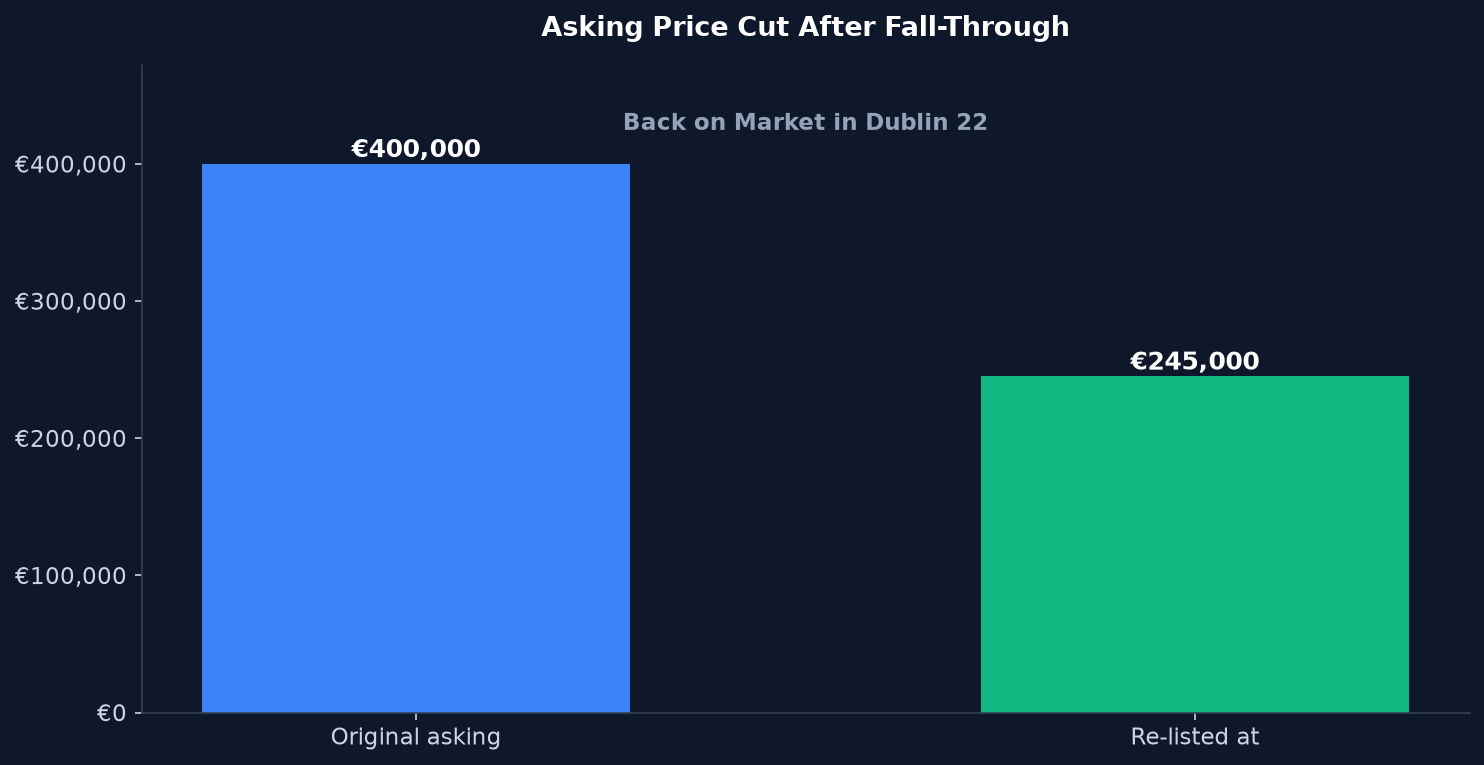
    Back on Market in Dublin 22: Asking Price Cut 39% (€400,000 → €245,000)

    44 Harelawn Drive, Irishtown, Dublin 22, Dublin

    Listing: View on portal

    • Original asking: €400,000
    • Re-listed at: €245,000
    • Price cut: 38.8% (€155,000 below original)

    A sale that had been agreed on this property appears to have fallen through — it is back on the market at a reduced price. This signals a motivated seller and potential negotiation headroom, but verify condition and history before bidding.

    > _Automated alert from the Irish Real Estate Agent watchlist system._

  • Back on Market in Co. Dublin: Asking Price Cut 4% (€495,000 → €475,000)

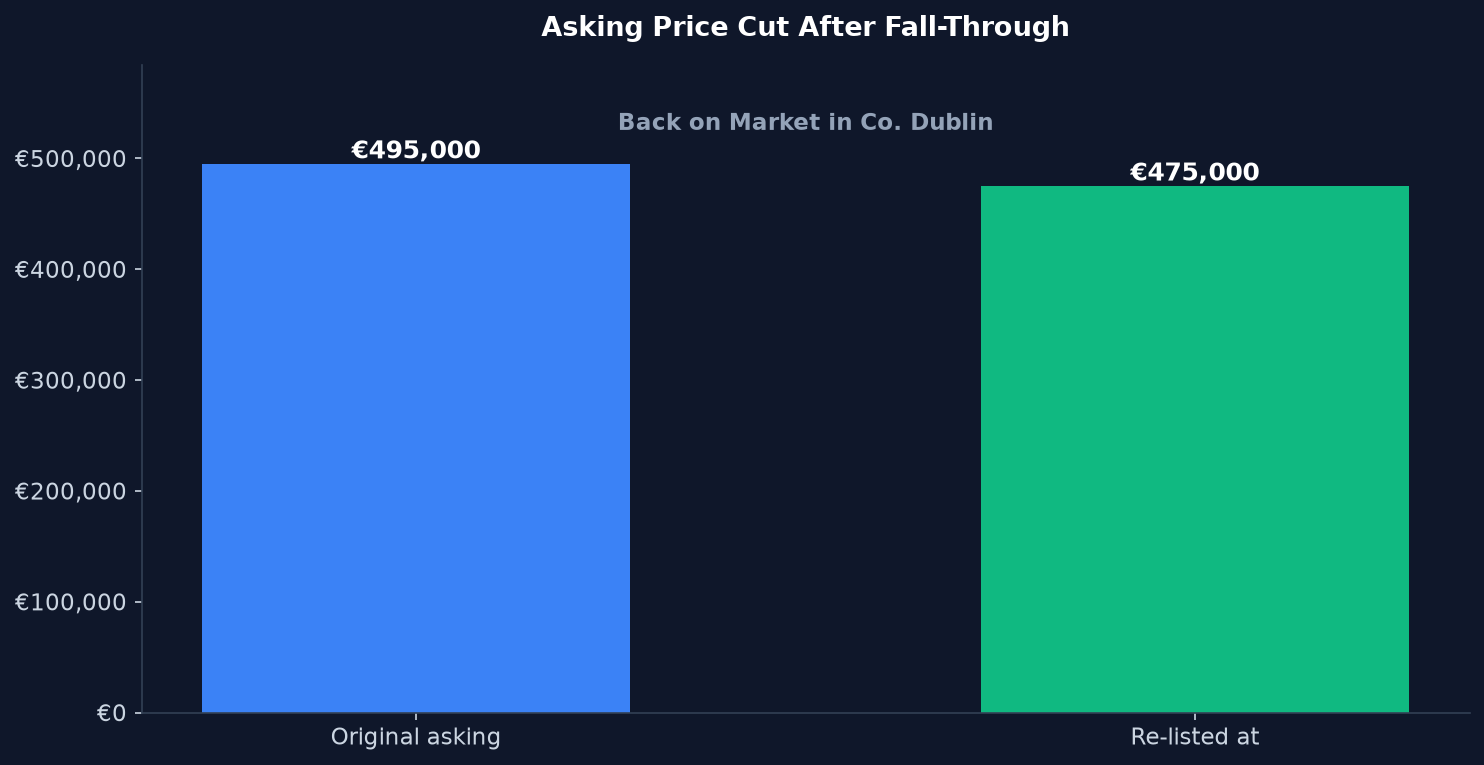
    Back on Market in Co. Dublin: Asking Price Cut 4% (€495,000 → €475,000)

    Two Sites 24A Grange Terrace And 24B Grange Terrace Mews Deansgrange Blackrock Co Dublin

    Listing: View on portal

    • Original asking: €495,000
    • Re-listed at: €475,000
    • Price cut: 4.0% (€20,000 below original)

    A sale that had been agreed on this property appears to have fallen through — it is back on the market at a reduced price. This signals a motivated seller and potential negotiation headroom, but verify condition and history before bidding.

    > _Automated alert from the Irish Real Estate Agent watchlist system._

  • Dublin Cultural Agenda: Week of 12 Oct 2026

    Dublin Cultural Agenda: Week of 12 Oct 2026

    Theatre (5)

    Music (4)

    • What’s On In Dublin | Events, Gigs, Festivals & More — dublintown.ie
    • Events | Dublin’s Best Live Music Venue | Famous Pub/Rock Bar [2026-10-12] · €16 — whelanslive.com
    • Music & Concerts Events in Dublin, Ireland – Live Music, Dances | Eventbrite [2026-10-16] — eventbrite.com
    • Tickets for concerts, festivals, music, gigs, clubs. Official Ticketmaster Site [2026-10-18] — ticketmaster.ie

    Exhibition (13)

    Comedy (5)

    Food (1)

    • Discover the Best Weekday and Weekend Food Markets in Dublin [2026-10-18] — visitdublin.com

    Festival (4)

    Family (5)

    • Dublin Family Fun – Find Perfect Family Activities in Dublin [2026-10-16] — dublinfamilyfun.ie
    • Discover Kids Workshop Events & Activities in Dublin, Ireland — eventbrite.com
    • Free Events – Family Fun — familyfun.ie
    • Discover Fun Family Things to Do in Dublin | Visit Dublin — visitdublin.com
    • Drop-by Workshops for Kids | Heritage Ireland [2026-10-18] — heritageireland.ie

    Other / To verify (1)

    • Things to Do in Dublin, Ireland This Week – Events & Activities | Eventbrite — eventbrite.com
  • Gross vs Net Yield in Dublin: What a Landlord Actually Keeps (2026)

    Gross vs Net Yield in Dublin: What a Landlord Actually Keeps (2026)


    Every Dublin property advertisement that quotes a yield is quoting the gross number — annual rent divided by price, with nothing deducted. Nothing for the letting agent. Nothing for insurance, Local Property Tax, the empty month between tenants, the boiler that dies in year three. And nothing for Revenue, which takes the largest single slice of any landlord’s rent at up to 52% on the margin.

    The yield you actually bank is the net yield — and the gap is the whole game of buy-to-let underwriting. On the registered-rent basis we use across this site, Dublin’s gross yields run from about 5.0% (Dublin 6) to over 10% (north inner city), with an all-Dublin average near 7%. Net those out properly and the honest range for a typical 40%-rate landlord is closer to 3–5%, with every percentage point between gross and net explained by one of five cost lines — and income tax explaining the biggest one.

    This guide is the tax-and-cost companion to our Dublin Rental Yields by Area 2026 district table. There we showed you which areas gross highest; here we show you what survives. You will get the full per-€1,000 cost stack, the 2026 income-tax mechanics landlords actually face (20%/40% bands, USC, PRSI, the mortgage-interest restriction and the €1,000 landlord credit), two fully-worked Dublin examples, and the capital-gains bill you meet on the way out.

    TL;DR: On a typical agent-managed Dublin let, roughly €250–310 of every €1,000 of rent goes to operating costs and voids before tax, and income tax takes a further slice that depends entirely on your marginal rate. A Finglas terrace grossing 8.4% nets to about 4.4% for a higher-rate landlord who claims the €1,000 landlord tax credit; a Dublin 12 home grossing 6.1% nets to about 3.2% on the same assumptions. The headline “2–3 point” gap usually understates it: expect a 3–5 point drop once you cost and tax the property honestly — and more if you are mortgaged.

    All tax rules below were checked on 5 September 2026 against Revenue.ie, Citizens Information and 2026-dated practitioner guides, and the district figures come from the registered-rent basis used across our yield tables.


    1. The gap: why “8% yield” quietly becomes “about 4%”

    Irish landlords love quoting gross yields because gross yields are flattering. It is not dishonest — it is just incomplete. The gross figure answers one question only: what would a cash buyer earn on the purchase price at today’s registered rent, before any cost or tax? It says nothing about what reaches your bank account.

    Here is the arithmetic of the gap in one line:

    Gross yield − operating costs (% of rent) − voids − income tax (% of taxable profit) = net yield

    On the full-cost basis, the series numbers in our district table put Dublin’s net yields roughly 2–4 points below gross — and the real-world drop for a mortgaged, higher-rate landlord is often larger, because mortgage interest (only 75% deductible in 2026, see Section 4) and the 52% top marginal rate compound the deduction.

    Three truths about the gap that most yield-spreadsheets ignore:

    • Tax is the biggest line, and it is personal. Operating costs are roughly similar for two landlords owning the same terrace. Their tax bills are not: one might pay 20% on the rental profit, the other 52%, because rental income is taxed on top of your other income. A guide that quotes “net yield” without naming a tax rate is hiding the variable that moves the number most. Every net figure in this article names its rate.
    • The gap widened again in 2025–2026. The mortgage-interest deduction was cut to 70% in 2025 and stands at 75% for 2026 (Section 4), while the €1,000 landlord tax credit (RPRIR, Section 3) partially offsets the damage for smaller landlords. Netting out, a geared 52%-rate landlord keeps less of the rent than at any point since the early 2010s.
    • Under the 2% rent cap, the Day-1 net is roughly the net you keep. Since 1 March 2026, in-tenancy rents can rise only by the lower of CPI or 2% a year (the national rent cap explainer); with CPI at 3.4%, the current cap is 2%. The old rescue strategy — buy thin on yield, let inflation re-rate the rent — is gone. If the net doesn’t work on day one, it will not grow its way into working.

    Landlords have noticed. Individual landlord numbers have fallen from roughly 170,000 in 2016 to under 140,000 (Census-2022-derived counts), and one Dublin agency reported that 62% of its 2025 sellers were investors offloading buy-to-lets — which is precisely why the rents left behind still support 7–10% gross yields for those willing to model the net properly.


    2. The cost stack: what happens to every €1,000 of rent

    Budget the way a lender underwrites: build the cost stack first, then decide whether the net clears your target. For a typical Dublin terrace let, the operating lines — before tax — run like this per €1,000 of passing rent:

    Cost line Typical range (per €1,000 rent) What it covers
    Letting agent / management €70–100 (7–10%) Finding tenants, rent collection, inspections, handling repairs and RTB paperwork. The single biggest discretionary line — self-manage and it largely disappears, but you buy the hassle.
    Insurance + Local Property Tax €50–70 Landlord buildings/contents/liability insurance (~€400–500/yr on a Dublin terrace) plus LPT (~€240–330/yr at current values).
    Repairs & maintenance €80–150 The annualised cost of the boiler service, the leak, the repaint between tenancies, appliance replacement. Older northside and inner-city terraces sit at the top of this range.
    Voids (empty periods) €30–50 The month between tenancies. In high-turnover districts (D1, D8) budget the top of the range; a well-kept Finglas or D12 terrace can run at the bottom.
    Accountancy, RTB fees, sundries €10–25 Annual registration €40, accountant, advertising, small items. Often forgotten; Revenue treats rent as a trade, so the books must exist.
    Total before tax €240–395 Roughly a quarter to two-fifths of gross rent gone before Revenue sees a euro.

    Using representative figures from the middle of those ranges — agent 8.5% (€85), insurance + LPT €55, maintenance €115, voids €40, sundries €15 — here is the honest map of €1,000 of rent for an agent-managed landlord:

    Line Per €1,000 Running total left
    Passing rent €1,000 €1,000
    Letting agent (8.5%) −€85 €915
    Insurance + LPT −€55 €860
    Maintenance & repairs −€115 €745
    Sundries (accounts, RTB, ads) −€15 €730
    Voids −€40 €690
    Net operating income (pre-tax) €690 €690

    Then tax. The void month was never received, so it is never taxed: taxable profit is the €960 actually collected less the €270 of deductible operating lines — €690 of every €1,000. The landlord’s marginal rate then decides what remains:

    Your marginal rate (Section 3) Tax on the €690 You actually keep per €1,000 Keep rate
    20% €138 €552 55%
    40% €276 €414 41%
    52% €359 €331 33%

    Read that bottom row slowly: at the 52% top rate, an agent-managed landlord keeps barely a third of every euro of rent. That single fact — not the purchase price, not the area — is why net yields across Dublin cluster in the 3–5% zone while gross yields advertise 6–10%.

    Callout — the two levers that matter most
    1. Your marginal rate (decided by your salary, not your property) moves the keep-rate from 55% to 33%.
    2. Self-management converts the €85–100 agent line into your own time. For a single property it is very doable — the RTB portal, standard tenancy paperwork and the 2% rent-cap rules are all well documented — and it is worth roughly 0.6–0.8 points of net yield on a €300k property.


    3. Tax deep dive: how Dublin rental income is actually taxed in 2026

    3.1 The 20%/40% bands — and where your rent lands

    Rental profit is not taxed in isolation. It is added to your other income for the year and taxed at your marginal rate — the rate your last euro of total income pays. The 2026 bands (held at the 2025 levels; Revenue’s tax relief charts):

    Status Income taxed at 20% Balance taxed at 40%
    Single / widowed First €44,000 Above €44,000
    Single Person Child Carer Credit First €48,000 Above €48,000
    Married couple, one income First €53,000 Above €53,000
    Married couple, two incomes First €88,000 (increase capped at €35,000) Above

    A single person with €30,000 of salary and €16,000 of taxable rental profit pays 20% on the first €44,000 — so all €16,000 of the rent is taxed at 20%, plus USC. The same person with €50,000 of salary pays 40% on the slice of rent above €44,000 — i.e., on €6,000 of it — and 20% on the rest. This is why two identical Finglas terraces can have genuinely different net yields: the tax rate is a property of the landlord, not the property.

    3.2 USC and PRSI: the stack that makes “52%”

    Income tax is only part of the bill. Rental income also attracts the Universal Social Charge, and landlords in the self-assessment (Class S) system pay PRSI on rental profits:

    • USC 2026: 0.5% up to €12,012; 2% from €12,012 to €28,700; 3% from €28,700 to €70,044; 8% from €70,044 to €100,000; 11% above €100,000.
    • PRSI (Class S, landlords): 4.2% for 2026 to 30 September, rising to 4.35% on 1 October 2026.

    Stacked on the 40% higher rate, that produces the famous “52%” top marginal rate — 40% income tax + 8% USC + ~4% PRSI — which applies to total income between about €70,000 and €100,000. Above €100,000 the 11% USC tier pushes the combined marginal to ~55% (40 + 11 + 4.35). The practical ladder for a landlord’s next euro of rent:

    Your total income Marginal on extra rent (IT + USC + PRSI)
    Up to €44,000 (single) ~20–25% (20% + low USC tiers + PRSI where applicable)
    €44,000–€70,044 ~43–47% (40% + USC 3%)
    €70,044–€100,000 ~52% (40% + USC 8% + PRSI ~4%)
    Over €100,000 ~55% (40% + USC 11% + PRSI 4.35% from Oct 2026)

    The examples in Section 5 use the three rates the market quotes — 20%, 40% and 52% — so you can read off your own situation. If you are PAYE-only and pay no PRSI on the rent, treat the 52% column as a slight overstatement and use ~48%; the mechanics are otherwise identical.

    3.3 What you can deduct (the allowable list)

    Revenue’s starting point: rent is treated as a trade, so expenses are allowable only if they are incurred wholly and exclusively for earning the rental income (Revenue — what expenses are allowed). The core list:

    • Repairs and maintenance — fixing what exists. Repainting between tenancies, a new boiler replacement part, a repaired roof. Improvements are not deductible — an extension, a new kitchen that upgrades the property, or a full rewire goes into your CGT base instead (Section 7).
    • Insurance — landlord buildings, contents and liability premiums.
    • Letting agent and management fees, advertising — fully deductible.
    • Mortgage interest — interest only, not capital repayments, and in 2026 only 75% of it is deductible (Section 4). Claiming it requires your tenancy to be RTB-registered.
    • RTB registration fees, accountancy fees, ground rent, service charges, utility bills you pay (e.g., in an all-inclusive let).
    • Wear-and-tear on furnishings in a furnished let: 12.5% per year over eight years (Section 6).
    • Local Property Tax — the annual charge on the property is a genuine cash cost of holding it; on whether it is also a deductible expense, Revenue practice has shifted and 2026 practitioner guidance is split. Treat it as a cost line in your yield maths and confirm the deduction position with your accountant before filing.

    Never deductible: the capital element of mortgage repayments; your own labour (you cannot pay yourself for painting); expenses before the property is first let (except the pre-letting relief below); anything for personal use; and — for most single-property landlords — ordinary travel between your home and the rental (Section 8).

    3.4 Pre-letting expenses: the €10,000 window landlords miss

    The big exception to “no deductions before the first let”: if a property has been vacant for at least 6 months and is then let as a residential tenancy, you can deduct qualifying pre-letting expenses incurred in the 12 months before the first letting — repairs and maintenance, insurance while vacant, legal and professional fees — up to €10,000 per property. The relief, introduced for vacant properties and extended in successive budgets, runs to 31 December 2027, and the tenancy must be RTB-registered and remain in the rental market (typically four years) or the deduction is clawed back.

    Worked: you buy a vacant Finglas terrace, spend €8,500 over seven months on a repaint, plumbing repairs, a BER assessment and fire-safety upgrades, then let it. At a 40% marginal rate that €8,500 saves you €3,400 in tax (at 52%, €4,420) — real money that most accidental landlords simply leave unclaimed because nobody told them the window exists.

    3.5 The €1,000 landlord tax credit (RPRIR)

    Budget 2024’s answer to landlord exits was the Residential Premises Rental Income Relief (RPRIR) — a direct tax credit, not a deduction, worth 20% of your rental profit up to a maximum of:

    • €600 in 2024 (20% of €3,000)
    • €800 in 2025 (20% of €4,000)
    • €1,000 in 2026 and 2027 (20% of €5,000)

    (Citizens Information — housing tax credits and reliefs). Conditions: it is a credit per landlord, not per property — you claim it once regardless of how many lets you run; the tenancy must be RTB-registered and tax-compliant; and it is clawed back if you sell or leave the rental market within four years. Because it is a credit (off your tax bill, not your profit), it is worth the same €1,000 to a 20% taxpayer as to a 52% taxpayer — and on a €250,000 property that is 0.4 points of yield. The worked examples in Section 5 include it; a landlord who fails to claim it is voluntarily giving away roughly that much net yield.


    4. The mortgage-interest restriction: what the 75% rule costs you, by bracket

    If you carry a mortgage on a Dublin let, the single most consequential tax rule you face is the mortgage-interest restriction.

    4.1 The rule in 2026

    Only the interest element of your mortgage payments is ever deductible — capital repayments never are. And since the current restriction cycle began in 2025, only a share of that interest qualifies:

    • 2025: 70% of mortgage interest deductible
    • 2026: 75% deductible — the level used throughout this guide
    • Direction of travel: restoration toward 100% is the stated aim, but no fixed date had been announced at the time of writing.

    The deduction also requires your tenancy to be registered with the RTB, and interest only counts from the date the property is let or available for letting — none of the pre-letting months qualify (Revenue — what expenses are allowed). If you see older material saying interest is “100% deductible again” — that was the position from 2019 to 2024, and it no longer reflects the 2026 rules.

    Callout — “Section 24”? That’s a UK rule.
    British landlord forums are full of “Section 24” — the UK restriction that replaced interest deductions with a flat 20% tax credit. Ireland does not do that. Irish landlords still deduct a percentage of the interest (75% in 2026) directly against rental income. If you are reading UK advice about mortgage-interest tax, the mechanics do not transfer.

    4.2 Impact by bracket: the restriction is a tax on your tax rate

    Here is the subtle cruelty of the 75% rule: the disallowed 25% of your interest is effectively taxed at your marginal rate. Every €1,000 of interest you actually pay:

    Your marginal rate Deductible (75%) Tax saved on the deduction Disallowed 25% taxed at your rate Extra tax vs full deductibility After-tax cost of €1,000 interest
    20% €750 €150 €50 €50 €850
    40% €750 €300 €100 €100 €700
    52% €750 €390 €130 €130 €610

    The higher your bracket, the harder the restriction bites — which quietly pushes geared properties further toward the 40%-and-above landlord who can least afford the drag. (For contrast: with full 100% deductibility the same €1,000 would cost a 52% landlord €480 after tax; the restriction raises it to €610.)

    On a yield basis: take the Finglas terrace from Section 5 — €246,000, bought with a 70% loan of €172,200 at 4.3%. That is about €7,400 of interest a year, of which €1,850 is disallowed. At 40% that restriction costs you ~€740 a year — 0.30 points of yield; at 52%, ~€960 — 0.39 points. Add that to the operating stack and the mortgage-interest drag before you ever compare a geared net yield to a cash-buyer net yield: geared net yields are typically 2–3 points below the cash-buyer numbers in our district table, and roughly a third of that gap is the restriction alone.


    5. Worked examples: two Dublin properties, gross to net

    Two real district archetypes from our yield table, run through the full stack. Assumptions in both: cash buyer (no mortgage — that drag is Section 4’s job), agent-managed at 8%, insurance + LPT €660/yr, repairs & maintenance €1,200/yr, sundries €180/yr, voids 3% (≈11 days a year), rent at the current registered-rent level, and the landlord claims the €1,000 RPRIR credit. These running costs sit at the lower-mid of the Section 2 ranges — a realistic budget for a well-kept terrace, not a worst case; if you prefer the nervous-budget midpoints, add roughly €700–1,000 of costs a year and knock ~0.3 points off every net yield below.

    5.1 Finglas (D11): 8.4% gross → about 4.4% net for a higher-rate landlord

    A two-bed terrace at the ~€246,000 district median, letting at €1,722/month — the ~8.4% gross yield Finglas advertises (Dublin 11, registered-rent basis):

    Line Annual Notes
    Passing rent €20,664 €1,722 × 12
    Less voids (3%) −€620 ~11 empty days a year
    Rent actually collected €20,044
    Letting agent (8%) −€1,653
    Insurance + LPT −€660
    Repairs & maintenance −€1,200
    Sundries (accountant, RTB) −€180
    Net operating income €16,351 79% of collected rent
    Income tax @ 40% −€6,540 taxable profit €16,351
    + RPRIR landlord credit +€1,000 2026 rate
    Net after tax €10,811

    Net yield: €10,811 ÷ €246,000 = 4.39% — call it 4.4%. The 8.4% headline became 4.4% in the bank: a 4-point drop, not the 2–3 points the marketing maths implies.

    How the tax bracket moves it (same property, same costs, RPRIR claimed):

    Landlord’s marginal rate Net after tax Net yield
    20% €14,081 5.7%
    40% €10,811 4.4%
    52% €8,848 3.6%

    5.2 Dublin 12 (Drimnagh/Crumlin/Walkinstown): 6.1% gross → about 3.2% net

    A redbrick or 1930s semi at the ~€324,000 D12 median letting at €1,647/month (~6.1% gross):

    Line Annual Notes
    Passing rent €19,764 €1,647 × 12
    Less voids (3%) −€593
    Rent collected €19,171
    Letting agent (8%) −€1,581
    Insurance + LPT −€660
    Repairs & maintenance −€1,200
    Sundries −€180
    Net operating income €15,550
    Income tax @ 40% −€6,220
    + RPRIR credit +€1,000
    Net after tax €10,330

    Net yield: €10,330 ÷ €324,000 = 3.19% — call it 3.2%. The 6.1% D12 headline nets to roughly half — a 2.9-point drop on a property that cost 32% more than the Finglas terrace to buy.

    Landlord’s marginal rate Net after tax Net yield
    20% €13,440 4.1%
    40% €10,330 3.2%
    52% €8,464 2.6%

    5.3 What the two examples prove

    • Price is the yield killer, not rent. Finglas and D12 collect almost identical rents (€1,722 vs €1,647/month) — yet Finglas nets 1.2 points higher because it cost €78,000 less. Every extra euro of purchase price has to be earned back in rent that the 2% cap will not grow for you.
    • The RPRIR credit is worth ~0.3–0.4 points on both (€1,000 ÷ price). It is the difference between “3.2%” and “2.8%” on D12.
    • Your bracket decides your asset class. At 20%, the D12 semi nets 4.1% — a respectable income asset. At 52% it nets 2.6% — below where many investors would put money in a deposit-plus strategy once risk is priced in. The same bricks are a different investment in different hands. That is why the “average landlord” is leaving Dublin’s market while the landlords who stay are disproportionately lower-rate, cash-buying, hands-on operators.

    6. Capital allowances: wear and tear on the contents, not the building

    Landlords ask about “depreciation” or “wear and tear” on the property itself. The short answer: there is none on the building. You cannot claim capital allowances on the purchase price, the structure, or improvements to a standard residential let — that “wear and tear” is gone (it never existed for private residential lettings in the way it does for commercial property). The building cost is recovered only when you sell, through the CGT computation (Section 7).

    What does exist is wear-and-tear on the contents of a furnished let — furniture, white goods, beds, sofas, appliances and fittings — at 12.5% of cost per year for eight years, i.e., the full cost spread across the asset’s life (Revenue — capital allowances on furniture and fittings):

    • You spend €2,400 furnishing the Finglas terrace → claim €300 per year for eight years (€2,400 × 12.5%) against the rent.
    • The allowance is only available for a furnished let. An unfurnished let earns no wear-and-tear at all.
    • Repairs to existing furnishings are an immediate revenue deduction; buying new furnishings is capital, and the 12.5% route is how you recover the cost.

    Rule of thumb for the yield model: if you furnish, add roughly 1–2% of the furnishing cost to annual deductions for eight years — it shaves the taxable profit slightly and, at 40%, every €1,000 of furniture saves you €400 of tax spread over eight years.


    7. CGT on the way out: 33%, PPR relief, and the “7-year rule” that mostly isn’t

    Yield is what the property pays you while you own it. The exit is taxed separately, under Capital Gains Tax (CGT) — and exit planning is where accidental landlords make their most expensive mistakes.

    7.1 The baseline: 33%, with a €1,270 annual exemption

    The standard CGT rate on property is 33%. Every individual has an annual exempt amount — €1,270 of gains (2026) — below which no CGT is due, and you can deduct buying and selling costs (solicitor, auctioneer, some survey and advertising costs) from the gain (Revenue — PPR relief).

    Worked — the straightforward investor exit: our Finglas terrace bought for €246,000 (plus €4,200 buying costs) sells for €330,000 (less €8,800 selling costs). Chargeable gain: €71,000. Less the €1,270 exemption → taxable €69,730 → CGT at 33%: €23,011. (Payment: by 15 December for disposals between January and November; by 31 January for December disposals. Filing: with your tax return by 31 October the following year.)

    7.2 PPR relief: when the property was (or is) your home

    If the property was ever your Principal Private Residence (PPR), part of the gain is exempt. The rules that matter:

    • The gain is apportioned by time: the periods you occupied the home are exempt; the periods it was let out are not (with one crucial grace).
    • The final 12 months of ownership always count as occupation — Revenue’s way of letting you sell your old home after you have moved into the new one (Revenue — PPR relief).
    • Certain absences count as deemed occupation (e.g., working away from home) — but letting the property to a tenant generally ends the deemed-occupation treatment.
    • Rent-a-room income (≤€14,000/year from a lodger in your own home) does not break PPR relief, and the exemption extends to gardens/grounds up to one acre.

    Worked — the accidental landlord: you lived in a house for 5 of the 12 years you owned it, then let it for 7 and sold with a €180,000 gain. Exempt period = 5 years lived + final 12 months = 6 years → half the gain exempt → taxable €90,000 → CGT €29,700. Had you sold after living there the whole time, the full gain would have been exempt.

    The trap: landlords who “temporarily” let their old home and let years slide discover the letting period is taxable in full at 33%, and that the four-year RPRIR and pre-letting hold periods have been silently resetting. If a former PPR is in your portfolio, model the exit before the letting runs long.

    7.3 The “7-year rule”: what it actually is, and why it almost certainly doesn’t apply to you

    Every landlord forum has a “seven-year rule” that supposedly makes property tax-free. Ireland’s actual CGT reliefs contain exactly one seven-year rule, and it is narrow:

    If you acquired a property between 7 December 2011 and 31 December 2014 and held it for at least seven years, part of the gain on sale is exempt: divide seven by the number of years owned to get the exempt fraction (7 ÷ 12 = 58% exempt after twelve years). (Revenue — property acquired 2011–2014)

    That was a crash-era stimulus for properties bought in the 2011–2014 window — purchases that closed more than a decade ago. For anything bought since 2015, including every property a 2026 buyer is considering, there is no seven-year rule: owning a rental for seven years exempts nothing, renting a home out for seven years does not reset PPR, and the UK’s “Section 24 / seven-year” folklore does not cross the Irish Sea. If you hear “hold it seven years and the CGT disappears,” the correct response is: ask to see the section of the Taxes Consolidation Act — because it is not there.


    8. Record keeping: the discipline that protects every deduction

    Revenue treats rent as a trade, and a trade needs books. The practical minimum for a Dublin landlord:

    • RTB registration — the master switch. Register every tenancy within one month of it starting (€40/year for a private tenancy, re-registered annually; late fees €10/month — Citizens Information). Registration is not optional paperwork: it is a condition of claiming mortgage interest relief and of the RPRIR credit, and an unregistered landlord is also exposed to RTB sanctions and fines.
    • Receipts and invoices for six years. Keep every deductible expense documented — agent statements, insurance renewals, repair invoices, the LPT receipt, interest certificates from your lender (issued each January). Revenue can request records for up to six years after filing; a repair you cannot evidence is a deduction you never had. Scan everything into a folder per property the day it happens.
    • Mileage and travel — log it, but expect a fight. Revenue’s “wholly and exclusively” test is strict on travel: ordinary trips between your own home and the rental property are generally not allowable, and some practitioners advise that single-property landlords should claim no travel at all. What is defensible — with a contemporaneous log — is travel that is genuinely part of running the let: trips between two rental properties, or to the letting agent to inspect or manage. Keep the diary; let your accountant decide what survives.
    • One bank account per property, or at least one separate account. Rent in, costs out, no personal spending in the middle. Clean records are the difference between a two-hour self-assessment and a Revenue compliance review.
    • File properly. Rental income is declared on your annual return: via myAccount (Form 12) if you are a PAYE taxpayer with modest rent, or ROS (Form 11) if you are a “chargeable person” — which you generally become once rental profits exceed about €5,000 a year. Self-assessment returns and preliminary tax are due by 31 October (ROS gets a little longer in mid-November). Late filing starts the penalty clock; a forgotten year can be amended within four years, but why test it.

    (Citizens Information — landlords’ rights and responsibilities)


    9. Frequently asked questions

    1. How is rental income taxed in Ireland in 2026?
    Rental profit (rent received less allowable expenses) is added to your other income and taxed at your marginal income-tax rate — 20% up to the standard-rate band (€44,000 for a single person), 40% above it — plus USC (0.5% to 11% by income tier) and, for landlords in the Class S system, PRSI at 4.2% (4.35% from 1 October 2026). The combined top marginal rate is about 52%, rising toward 55% above €100,000 (Revenue — tax relief charts).

    2. What is the difference between gross yield and net yield?
    Gross yield is annual rent ÷ purchase price — no costs, no tax. Net yield subtracts management, insurance, Local Property Tax, maintenance, voids and income tax at your marginal rate. A Finglas terrace advertising 8.4% gross nets to about 4.4% for a 40%-rate landlord (Section 5) — the marketing number is what the property could earn; the net number is what you keep.

    3. What is the landlord tax credit in 2026, and how do I claim it?
    The Residential Premises Rental Income Relief (RPRIR) is a direct tax credit worth 20% of your rental profit, capped at €1,000 for 2026 and 2027 (€600 in 2024, €800 in 2025). It is one credit per landlord (not per property), requires an RTB-registered, tax-compliant tenancy, and is clawed back if you sell within four years. Claim it in your income-tax return — it is worth ~0.3–0.4 points of net yield.

    4. Is mortgage interest fully deductible for landlords in 2026?
    No. In the current restriction cycle only 75% of qualifying mortgage interest is deductible in 2026 (70% in 2025), the interest must relate to a loan used to buy, improve or repair the let property, the tenancy must be RTB-registered, and only interest from the date the property is let or available counts. Capital repayments are never deductible. The disallowed 25% is effectively taxed at your marginal rate (Section 4).

    5. I keep hearing about “Section 24” for landlords — does it apply in Ireland?
    No — Section 24 is a UK rule that replaced interest deductions with a 20% tax credit. Ireland uses a different mechanism: landlords deduct a percentage of mortgage interest (75% in 2026) against rental income. Treat UK landlord tax advice as UK-specific.

    6. Can I claim expenses before my property is first let?
    Yes, under the pre-letting relief: if the property was vacant for at least 6 months, expenses incurred in the 12 months before the first letting (repairs, insurance, legal fees) are deductible up to €10,000 per property. The relief runs to 31 December 2027; the tenancy must be RTB-registered and stay in the rental market for about four years or the deduction is clawed back.

    7. Can I claim wear and tear on my rental property?
    On the building, no — there are no capital allowances on the structure or on improvements. On the contents of a furnished let, yes: wear-and-tear at 12.5% of cost per year for eight years on furniture, white goods and fittings (Revenue).

    8. What is the seven-year rule for CGT in Ireland?
    There is only one, and it is closed: properties acquired between 7 December 2011 and 31 December 2014 and held seven years or more get partial relief (7 ÷ years owned of the gain exempt). For anything bought since 2015 there is no seven-year rule — holding a rental for seven years exempts nothing, and letting your former home does not reset PPR relief. The standard exit tax is 33% on gains above the €1,270 annual exemption.

    9. I rent out a room in my own home — is that different?
    Yes. Rent-a-room relief exempts up to €14,000/year of income from a lodger in your PPR (including meals and utilities payments) from income tax, USC and PRSI, and it does not affect your PPR relief when you sell (Citizens Information — rent a room). It is not available for short-term lets or for renting out a whole separate property.

    10. What happens if my rental income is less than my expenses in a year?
    If costs and the deductible share of interest exceed the rent, the loss is generally carried forward and offset against future rental profits of that rental business — it does not reduce tax on your salary. And remember: a “loss” is computed on allowable expenses only — mortgage capital repayments and your own labour never count, so a cash-negative year is not automatically a tax-loss year. Run the numbers (or pay an accountant) before concluding you have a loss to carry.


    10. Bottom line: the six numbers that run Dublin buy-to-let maths

    1. Gross is rent ÷ price; net is what survives costs and tax. Never underwrite a purchase on the gross figure.
    2. €250–€310 of every €1,000 of rent goes to operating costs and voids before tax — agent 7–10%, insurance+LPT 5–7%, maintenance 8–15%, voids 3–5%.
    3. Your marginal rate (20/40/52%) moves the keep-rate from 55% to 33%. The property is identical; the landlord’s salary decides the yield.
    4. 75% mortgage-interest deductibility in 2026 — the restriction costs a 40% landlord €100 per €1,000 of interest, and ~0.3 points of yield on a geared Finglas purchase.
    5. €1,000 RPRIR credit (2026–2027) is ~0.3–0.4 points of free yield on a typical Dublin property — claim it or lose it.
    6. 33% CGT and the €1,270 exemption on exit, with PPR relief covering occupation plus the final 12 months — and no general seven-year rule.

    Your next steps

    • Buying or holding? Start from the district yield table for the gross side, then rebuild each shortlisted property through the Section 5 model at your tax rate — the site’s free consultation will walk a shortlist through the net maths.
    • Rents and the cap? The 2% national rent-cap explainer is the ruleset every landlord now operates under; model rents as growing at ~2%, not at market rates.
    • Get the data, not the guesswork. Download “Dublin by the Numbers 2026” — our free PDF with every shortlisted district’s medians, growth and yields on one screen, refreshed quarterly.
    • Own your paperwork. Register the tenancy with the RTB on day one, keep six years of receipts, and claim the RPRIR credit and any pre-letting expenses every year they apply. Most of the money landlords leave on the table is not exotic — it is unclaimed credits and undocumented deductions.
    • Browsing the wider picture? All our investor guides and area analyses live in the investment analysis library.

    Tax rules verified on 5 September 2026 against Revenue.ie (rental-income expenses, PPR relief, tax relief charts), Citizens Information and 2026-dated practitioner guidance; district rents and prices from the RTB Rent Register and Property Price Register via our registered-rent yield series (March 2026 update). This guide is general information, not tax or legal advice — yields and reliefs depend on your personal circumstances, so model your own numbers (with a tax advisor where it matters) before committing capital. Date to watch: PRSI rises from 4.2% to 4.35% on 1 October 2026.

    Related guides

  • Buying on the MetroLink Corridor in 2026: Ballymun, Glasnevin & Future-Station Areas

    Buying on the MetroLink Corridor in 2026: Ballymun, Glasnevin & Future-Station Areas


    If you are house-hunting anywhere on the northern side of Dublin this year, the same question keeps coming up: should you buy near a future MetroLink station? The answer is not “yes” — it is “yes to some stops, no to others, and it depends entirely on what you can spend and how long you can wait.” If your search for “MetroLink stations Dublin property” keeps circling back to two suburbs, that is not an accident: Ballymun and Glasnevin are the corridor stops with actual houses around them, and they are where the buying decision is real. The corridor now has a legal green light: the Railway Order became operative on 12 January 2026, procurement is running in parallel streams, and the Minister says ground will break in August 2027 (metrolinkro.ie; Irish Independent). That makes 2026 the window when the interesting price decisions happen — before the diggers arrive and before any confirmed opening date starts compressing the timeline.

    This is the buying-focused guide to the corridor’s two real residential neighbourhoods — Ballymun, where the median price is €246,000 and growth is running at 8.4%, and Glasnevin, at €355,500 with 7.3% gross rental yield — plus a realistic read of the other station areas (Mater, O’Connell Street, Tara, Charlemont) and the future stops that do not exist yet. It is the neighbourhood-spotlight companion to our full MetroLink corridor property guide . All market figures were verified on 5 September 2026.


    1. MetroLink status 2026: approved, in procurement, digging from August 2027

    Before any buying maths, the project status — because every price and yield below is a bet on this schedule:

    Milestone Date Detail
    Railway Order granted 30 Sep 2025 An Coimisiún Pleanála approved the Railway Order (RO) for the 18.8 km, 16-station line (metrolinkro.ie)
    Railway Order operative 12 Jan 2026 RO operative under s.43(4), Transport (Railway Infrastructure) Act 2001 — TII may now build and acquire land (metrolinkro.ie)
    Funding locked Nov 2025 €2bn from the Infrastructure, Climate and Nature Fund for MetroLink 2026–2030, within the €24.3bn Sectoral Investment Plan for Transport (TII)
    Enabling-works procurement 2026 Frameworks for utilities, archaeology and the Dublin Airport station box, which must finish before major tunnelling (MetroLink; ENR)
    M500 concession launched May 2026 Design–Build–Finance–Operate–Maintain contract for trains, track, stations and systems plus 25 years of operation; notice value €7.3bn NPV (MetroLink)
    Main civil packages award target Q3/Q4 2027 Separate civil and rail-systems packages, three bidders shortlisted each (ENR)
    Construction start target Aug 2027 “We will break ground next August,” Transport Minister Darragh O’Brien said in June 2026; opening could be phased (Irish Independent)
    Build duration 6–8 years Project guidance; no official opening date confirmed as of 2026 (Wikipedia)

    The scale is the point: a fully segregated, automated, mostly underground metro built for up to 20,000 passengers per direction per hour at peak, initially every three minutes — the largest public-transport infrastructure investment in the State’s history, and the defining Dublin metro investment decision of the decade for anyone buying near its stations (ENR). For a buyer, three things follow:

    1. The legal risk is mostly gone. The Railway Order survived judicial review — a Ranelagh challenge was lodged in November 2025 and withdrawn the following month — so the alignment and station list are fixed unless cost forces a change (Wikipedia). You are no longer betting on whether the line happens; you are betting on when it opens.
    2. The timeline risk is real and long. Construction is targeted to start in August 2027 and take six to eight years, with phased opening already mooted. On the current schedule the first trains run around the mid-2030s — which means a buyer today is underwriting a 2035 commute (Irish Independent).
    3. The price-moving window is now. The Luas evidence (Section 7) says the biggest relative moves happen in the announcement-to-construction phase and again around opening. The Railway Order operative date is the announcement; the diggers are the confirmation. Between them sits 2026–2027 — the period when sellers start pricing the metro in and buyers can still find stock that has not.

    2. Buying near a MetroLink station: what each corridor area costs in 2026

    The corridor runs 18.8 km from Estuary in Swords to Charlemont on the Grand Canal, with 16 stations (metrolinkro.ie). Only some of those stops sit in real residential neighbourhoods — the rest are airport, business-park or city-centre interchanges. For buyers, six station areas matter, and the district figures below use the same PPR-based series as every guide in this category (Dublin house prices by area; Dublin rental yields by area):

    Station area Postcode(s) Median (2026) 1-yr growth Gross yield Buyer read
    Ballymun D11 (Finglas & Ballymun) €246,000 +8.4% ~8.4% Cheapest serious corridor market; biggest re-rating candidate; FTB and investor battleground
    Glasnevin D9 (Glasnevin & Drumcondra) €355,500 +6.7% ~7.3% Family-belt compounder; three rail investments converging
    Mater D7 / D9 / D1 edge D7: €330,000 +7.5% ~7.9% Hospital + Phibsborough catchment; Luas Cross City already there
    O’Connell Street D1 (north inner city) €275,000 +6.3% ~10.2% Apartment-led, income-driven city-centre stock
    Tara D2 (south of the Liffey) No D2 series; Dublin city €480,000 (CSO) — — DART interchange; office and Docklands flows; apartments
    Charlemont D2 / D6 edge D6: €595,000 +6.0% ~5.0% Southern terminus; premium market; defence, not discovery

    Sources: PPR-based district medians and growth (Dublish, March 2026 update); CSO RPPI June 2026 for the Dublin city median (CSO). Gross yields divide RTB registered rents by PPR sale prices; they run below asking-rent series, and net yields run roughly 2–3 points lower after mortgage interest, tax, property tax, insurance and voids. Against all of this: the Dublin region median is €500,000 and Dublin prices are growing 4.6% year on year (CSO) — Ballymun’s district is growing at nearly twice the city rate from a base half the regional median.

    Ballymun and Glasnevin get the full deep dives (Sections 3–5). The other station areas are summarised in Section 6, because they behave more like each other than like the two suburbs — and because the real future-station story for buyers sits north of the city centre, in stops that are approved but not yet built.


    3. Ballymun property prices in 2026: the corridor’s biggest re-rating candidate — and what to buy there

    The numbers

    If you track Ballymun property prices in 2026, the headline is a combination no other corridor stop matches. Dublin 11 (Finglas and Ballymun together) has a €246,000 median sale price, +8.4% annual growth and a ~8.4% gross rental yield on the registered-rent basis (Dublish; Dublish yields). That is roughly half the €500,000 Dublin regional median, growing almost twice as fast — the strongest median-plus-growth-plus-yield combination on the corridor. Ballymun also gets two MetroLink stops bracketing the suburb — Ballymun itself and Northwood at the business campus on its edge — and the Ballymun Library is even an official public-inspection point for the Railway Order documents, which tells you how central the suburb is to the project (metrolinkro.ie).

    What is actually for sale (snapshot, early September 2026)

    The D11 median blends every kind of sale — original-condition houses, regenerated estates, private apartments and new mixed-tenure developments — so look at what the median is made of. On Daft.ie when we checked, Ballymun’s listings split roughly 56% houses to 44% apartments, with a median asking price around €265,000 for a 2-bed apartment and around €462,500 for a 3-bed house — asking prices on mostly upgraded or new stock, well above the €246,000 all-sales median (Daft.ie — Ballymun). Real examples from the same snapshot:

    • €265,000 — 2-bed apartment at The Plaza complex (D09 eircode), asking
    • €310,000 fixed price, no bidding — 3-bed, 2-bath townhouse at The Charter, Santry Cross, Dublin 11, BER B3 (service charge ~€2,659/yr)
    • €304,000 sold vs €245,000 asking — a 2-bed, 2-bath apartment that went ~24% over its guide (Daft.ie — sold in Ballymun)

    The last line is the one to internalise: asking prices at the cheap end of the corridor are guides, not prices, and bidding there has been aggressive on well-priced stock. Listings turn over weekly, so treat this as a flavour of the market and check the live pages before you bid (Daft.ie; MyHome).

    The regeneration engine (2025–2028)

    Ballymun is not a metro bet on an empty plot — it is a suburb mid-transformation, with three catalysts arriving before the metro:

    • BusConnects first. The Ballymun/Finglas to City Centre Core Bus Corridor construction contract went to GRAHAM in December 2025 (announced 15 December, signed 19 December), with site works expected through 2026 (BusConnects; scheme site). Ballymun gets a genuinely better bus service years before the metro — which supports rents and prices in the gap.
    • The town centre is being rebuilt. The Land Development Agency is bringing forward 564 apartments — studio to three-bed, in three blocks of six to twelve storeys — on the Silloge Road lands in the heart of Ballymun Town Centre, on the old shopping-centre site, the tallest residential scheme in the suburb since the towers were demolished. Public consultation ran in July 2026 (including a drop-in at the Axis Centre on 15 July), a planning application is targeted for Q4 2026, and construction could start in 2028 (Irish Times; LDA; Dublin People).
    • The housing pipeline is running. The largest social-housing development since the towers fell — 288 homes on the former flat-block sites — was approved for delivery in early 2025, and the local-area plan envisages roughly 2,000 more homes, mostly apartments, on vacant land (Irish Times; Irish Times archive).

    That pipeline matters twice over for buyers: it is what changes the feel of the suburb before the metro arrives, and its new-build homes are exactly where Help to Buy and the First Home Scheme apply (schemes that do nothing for second-hand terraces — see the first-time-buyer section of our MetroLink corridor guide for the full scheme maths).

    Who can buy here, and what the maths says

    Central Bank rules cap first-time-buyer mortgages at 4× gross income with a minimum 10% deposit on the first €500,000 (Central Bank). Against Ballymun’s €246,000 median:

    • A single buyer on ~€55,000 can borrow ~€220,000 and, with a €24,600 deposit, reach the D11 median — the corridor’s only genuinely single-income entry point.
    • A couple on €80,000 combined can borrow ~€320,000 and reach well above the median — the €310,000 fixed-price Santry Cross townhouse is inside reach with a €34,500 deposit.
    • An investor buying at the median on a 10% deposit faces gross rent of roughly €1,700+/month implied by the ~8.4% gross yield — the income largely carries the wait for the metro, which is why the yield story matters on this side of the corridor.

    Fees run on top: stamp duty at 1% on the first €1m, solicitor ~€950–€2,500 + VAT, survey €400–€700 — roughly €5,000–€7,000 above the deposit on a €260,000 purchase (CCPC). And expect to pay a premium at the sharp end: Dublin homes below €500,000 sold roughly 10% above asking through 2025, and citywide bidding ran ~6.9% over asking in Q1 2026 (Owen Reilly; Herbert & Lansdowne on Daft Q1 2026) — so view homes listed about 10% below your ceiling.

    The honest caveats before you bid in Ballymun

    • Tenure mix varies street by street. Inside the old regeneration area, owner-occupation reached only about 28% — most households remain in social housing — so the private stock that trades is scarce and the mix differs from cul-de-sac to cul-de-sac (Irish Times). Ask the agent for the tenure breakdown on the specific development before you fall for a house.
    • Amenity is still arriving. Ballymun’s retail and café base is thinner than Glasnevin’s today; the town-centre rebuild and the 2028 LDA apartments are the plan, not the reality.
    • The wait is a decade, not a year. On the current schedule the suburb stays bus-only until the mid-2030s. Buy here because the regeneration and the numbers work on their own — treat the metro as the upside, not the reason.
    • Apartment service charges run €2,000+/yr on newer complexes and eat into net yields — check them before you underwrite a rental.

    Where to buy: the pockets on the Main Street/Ballymun Road transport spine closest to the two metro stops and the BusConnects corridor, and around the new town-centre development. A quiet cul-de-sac far from both is a different, slower investment.


    4. Glasnevin property prices in 2026: the family-belt compounder

    The numbers

    Glasnevin is the corridor’s calm play, and its numbers are the polite version of Ballymun’s: €355,500 median in Dublin 9 (Glasnevin and Drumcondra), +6.7% annual growth, ~7.3% gross yield (Dublish; Dublish yields). The stock is the difference: Victorian and Edwardian red brick around Griffith Avenue, mature semis, tree-lined streets, the National Botanic Gardens, Glasnevin Cemetery and DCU’s main campus — around 19,000 students across DCU’s sites, with the Glasnevin campus and a sports campus on the Ballymun Road (DCU). This is the corridor’s family-and-rental belt, and it does not need a metro to be a good place to buy — it needs growth to continue, and it has three rail investments pointing at one postcode:

    • MetroLink Glasnevin station is planned as a heavy-rail interchange with Iarnród Éireann (Wikipedia).
    • DART+ West will electrify and intensify the Maynooth and M3 Parkway lines; Iarnród Éireann’s preferred option includes a new fully integrated Glasnevin/Phibsborough station serving both DART+ and MetroLink. Its Railway Order became operative in June 2025, with enabling works expected from 2026 (Iarnród Éireann; DART+).
    • The Luas Green Line already runs at Broombridge on the district’s edge (Cross City, opened December 2017), roughly a kilometre from the village core, and Drumcondra’s rail station serves the northern edge (Wikipedia).

    No other corridor stop has that stack. Glasnevin is already a functioning transport node; the metro and DART+ make it a junction.

    What your money buys (snapshot, early September 2026)

    The €355,500 median mixes apartments with houses, so the market splits in two (Daft.ie — Glasnevin):

    • Around €350,000–€400,000: compact terraces needing work on the district’s edges, and 2-bed apartments in the established complexes (River Gardens on Glasnevin Hill and similar). This is the realistic FTB entry to D9 — and note that much of it sits on the D11 side of Glasnevin’s boundaries (Ballymun Road, Finglas Road edges), where prices run softer than the red-brick core.
    • €450,000–€650,000+: the Griffith Avenue red-brick market. Recent sold listings include extended period homes at €575,000–€605,000 (one end-of-terrace sold at €605,000 against a €575,000 asking price) (Daft.ie — sold in Glasnevin; Kelly Bradshaw Dalton). Fully renovated, extended red brick on the Griffith Avenue side is the top of the local market and trades accordingly.
    • The borrowing maths: a couple on €100,000 combined can borrow ~€400,000 and, with a ~€44,500 deposit, reach comfortably into D9’s median territory; a couple on €80,000 reaches the median only at the very top of their approval — so the realistic Glasnevin FTB entry is the apartment-and-compact-terrace band, or bidding discipline on the softer edges.

    The rental and family case

    The rental side is underpinned by DCU: student and staff demand keeps lettings active year-round, which is why the ~7.3% gross yield holds up despite the higher purchase price (Dublish). Implied average registered rent at that yield is roughly €2,150/month — again, new-let asking rents run higher and net yields run 2–3 points lower.

    For families, the school belt is real and verified: Dominican College Griffith Avenue (girls’ secondary, ~800 pupils), Holy Faith Secondary School on the Glasnevin side, and St Vincent’s CBS (boys’ secondary, Finglas Road) are the best-known local secondaries, with primaries to match — but enrolment pressure is normal in D9, so verify catchments against each school’s published admissions policy (Dominican College; gov.ie school record; Department of Education school finder).

    The honest caveats in Glasnevin

    • The median understates the house market. €355,500 is a blended figure; a house in the Griffith Avenue core starts well above it. Buyers anchored on the median will be surprised by asking prices on the red-brick streets.
    • Century-old stock has century-old problems: BERs are often poor, parking is on-street in the core, and extensions vary in quality and compliance. Ask for the BER before bidding and budget for retrofit on anything pre-1920.
    • The yield premium sits in the wrong pockets for a family buyer — student-heavy areas near DCU rent well but are not where you want to raise a family. The two goals point to different streets.
    • Growth is steadier than Ballymun’s — which is exactly why it is lower-risk. Glasnevin does not need a re-rating to work; it needs compounding to continue.

    5. Ballymun vs Glasnevin: which corridor neighbourhood should you buy?

    Ballymun (D11) Glasnevin (D9)
    Median sale price €246,000 €355,500
    1-yr growth +8.4% +6.7%
    Gross yield (registered-rent basis) ~8.4% ~7.3%
    Typical stock Regenerated estates, apartments, new mixed-tenure Red brick, mature semis, apartments
    MetroLink stops Two (Ballymun + Northwood) One, as DART+ interchange
    Other rail BusConnects (2026), no rail today Luas Green (Broombridge), Drumcondra rail, DART+ West
    Single-buyer reach Yes (median ≈ 4× on ~€55k income) Mostly no (needs ~€89k income or a partner)
    Family stock Emerging; tenure mix varies by street Established; verified school belt
    Upside Re-rating candidate — but a decade-long wait Compound growth — fewer ways to be wrong
    Main risk Timeline, tenure mix, thin amenity today Overpaying for the red-brick premium; period-stock costs

    The honest summary: Ballymun is the bet, Glasnevin is the balance. If you are a first-time buyer whose approval tops out near €250,000–€300,000, or an investor who wants income to carry a long wait, Ballymun is where the corridor’s upside is priced cheapest — but you are buying a transformation story and must underwrite a mid-2030s payoff. If you are a family, a couple on a stronger combined income, or a buyer who wants schools and amenity now, Glasnevin costs €110,000 more at the median and is worth most of it — the question there is whether the red-brick premium has already run. Both beat the city-centre stops for most buyers, because those are apartment markets with a different risk profile entirely (Section 6).


    6. The future-station play: Mater, O’Connell Street, Tara, Charlemont — and the stops that don’t exist yet

    The four city stops (confirmed stations, urban catchments)

    Mater — serves the Mater Hospital on Eccles Street and the residential ring around it: Phibsborough’s terraces, the North Circular Road apartments and the north-inner-city streets. Its catchment is Dublin 7 plus the D1 edge — D7 median €330,000, +7.5% growth, ~7.9% gross yield (Dublish). It gains the least novelty: the Luas Cross City line already runs through Phibsborough (opened 2017). For buyers, this is the stop where our Dublin 7 (Phibsborough & Stoneybatter) house-prices guide is the right read — the metro adds a second line to a neighbourhood that is already gentrifying.

    O’Connell Street — the north side’s busiest interchange, where MetroLink meets the Luas Cross City lines. The catchment is D1 apartment stock: €275,000 median, +6.3%, ~10.2% gross yield — small units, income-driven rather than family-driven (Dublish). TII bought the former Carlton Cinema in July 2026 for the station entrance, a reminder that city-centre land values are already moving around the alignment (Wikipedia). Buy here for yield and city living, not for a garden.

    Tara — the DART/Commuter interchange, whose catchment is the whole south-east rail basin: office and Docklands flows, apartment-led stock. There is no D2 median in our district series; benchmark against the €480,000 Dublin city median (CSO). A commuter’s stop, not a neighbourhood play.

    Charlemont — the southern terminus, interchanging with the Luas Green Line on the Grand Canal at the Ranelagh border. The premium southside market begins here at a €595,000 Dublin 6 median with ~5.0% gross yield (Dublish). The read is the reverse of Ballymun’s: already expensive, so MetroLink defends values rather than creating a re-rating. If you want the metro’s uplift maths working hardest, you are on the wrong end of the line at Charlemont.

    The stops that don’t exist yet: Collins Avenue, Griffith Park, Northwood

    North of Glasnevin and south of the airport sit three approved stations whose catchments are only partly built today — and this is where the “buy before the diggers” logic is sharpest:

    • Collins Avenue (DCU/Whitehall) — will sit at the DCU edge of Whitehall, a student-and-staff catchment wrapped around one of the country’s biggest universities plus the St Aidan’s CBS and Whitehall school belt (Wikipedia). DCU is not going anywhere; demand around the campus is structural. The stock nearby is a genuine mixed bag of 1930s–1970s houses and apartments, with DCU-related lettings underpinning yields. This is arguably the corridor’s best undiscovered family-and-rental hybrid — a Collins Avenue address today is priced as a decent D9/D11 edge, not as a two-minute walk to a metro serving the airport and city.
    • Griffith Park (Finglas Road) — named for the park beside the Finglas Road, this is the stop where Finglas meets Glasnevin’s southern edge. Its catchment is where D11’s cheaper stock starts rubbing against D9’s schools — an arbitrage pocket for buyers who want Glasnevin-adjacent family amenity at Ballymun-side prices. Expect the 0.5–1.5 km walkable ring around the planned entrance to be the battleground as construction approaches.
    • Northwood — the large office campus on the DCU edge between Ballymun and the airport. It brackets Ballymun with a second stop and serves the office catchment; for buyers it matters as the northern anchor of the Ballymun regeneration area.

    A note of caution for all three: these stops are on the operative Railway Order, but their entrance locations and phasing will be refined during detailed design and enabling works, and the land around them is not yet assembled. Do not pay a “station premium” today for a station whose door you cannot yet stand at. The disciplined move is the one the Luas data supports everywhere: buy the 500 m to 1.5 km walkable ring — close enough to walk, far enough that you are buying a house, not a station concourse (PropertyData).


    7. The Luas precedent: what rail actually did to prices — and the 40–60% claim, examined

    Both bulls and bears argue from the same episode — the Luas Green Line, which opened on 30 June 2004 from St Stephen’s Green to Sandyford and was extended to Bride’s Glen at Cherrywood on 16 October 2010 (Wikipedia — Green Line). Corridor commentary sometimes claims that homes near Green Line stops saw uplift of roughly 40–60% versus off-corridor areas across the 2004–2010 window. That figure is repeated often enough to deserve a health warning: we could not re-verify a 40–60% range against published primary research at writing. The peer-reviewed and data-led evidence points to a smaller, better-documented effect:

    • A standing premium, not a one-off spike. Geocoding 40,896 Property Price Register sales from 2024–25, Property Data Ireland found homes within 1 km of a Green Line stop sell around a +15% premium versus homes beyond 3 km of any stop — and measured a +27% DART premium and a negative Red Line one, the cautionary half of the story (PropertyData).
    • Faster appreciation after opening. TU Dublin research found prices within 1 km of Green Line stops rose faster than comparable areas after opening — the direct evidence for a real tram effect rather than pre-existing wealth (PropertyData). Daft’s 2018 analysis put the sales premium at ~15% (about €61,000) within 1 km of a stop, with rents ~15% higher too (TheJournal.ie); its earlier 2016 Rail Report found an average ~6% premium across DART and Luas, with the Green Line’s extension adding over 10% around Cherrywood (TheJournal.ie).
    • The sweet spot is not the station door. The 0–500 m band prices below the 500 m–1.5 km ring, because station-front land fills with apartments; the family-house premium sits in the walkable 0.5–1.5 km band, worth roughly €115,000 versus transit-free Dublin (PropertyData).
    • The Red Line is the limit case. Rail access alone did not transform Tallaght or Saggart; transit amplifies demand that already exists (PropertyData). The northside lesson: Ballymun’s re-rating depends on the regeneration and BusConnects work happening, not on the rails alone.

    What that means for the corridor: underwrite on the verified range — a real but modest premium (roughly 10–15% in the walkable ring), faster appreciation after opening, and the effect concentrated in neighbourhoods already improving. If the 40–60% figure ever turns out to be true for a specific stop, it will be because that stop was in a genuinely transforming area with a long construction runway — which is, precisely, the Ballymun thesis. But it is an unverified industry claim, so do not pay 2035 prices in 2026 on the strength of it.


    8. The risks: timeline, funding and the value-capture question

    1. Timeline slippage. An operative Railway Order is not a shovel. Main contract awards target late 2027, the August 2027 ground-breaking is a ministerial target, and no opening date is official — phased opening has already been floated, and a decade-plus of construction on a mostly underground line through Georgian and medieval Dublin carries archaeology risk no one can price out (Wikipedia; Irish Independent). Every slip pushes the payoff later, and it is the buyers at the discount stops — who need the payoff most — who feel it most.
    2. Cost and funding. The 2021 planning estimate was €7–12bn; €2bn of Climate and Nature Fund money was committed in November 2025; and July 2026 reports put a possible Cabinet preliminary budget at up to €19bn, with higher published figures disputed by the Minister (Wikipedia; TII; Gript). A heavier final business case raises the odds of scope or phasing changes. The station list is fixed unless cost changes it — cost is the one force that could.
    3. Value capture. Governments have discussed taxing the windfall that public infrastructure creates for landowners for years without enacting it: the 2021 General Scheme of the Land Value Sharing and Urban Development Zones Bill never progressed, and the OECD documents Ireland’s reliance on developer contributions rather than true value capture (OECD). A future levy is plausible precisely because MetroLink is so large — and it would most plausibly target development land and large sites, not existing homes. For the second-hand buyer this is a watch-item, not a deal-breaker; for anyone buying a plot or a site near a stop, it is a genuine underwriting risk. Watch the autumn Budget and the final business case.
    4. Overpaying for the promise. The classic megaproject mistake is paying 2035 prices in 2026. The expensive southern stops and much of Glasnevin have limited re-rating headroom; the discount markets hold the upside — but only if the regeneration arrives with the rails. And with homes below €500,000 already selling ~10% over asking, part of the metro story is already in Ballymun’s prices too.

    9. Frequently asked questions

    Will MetroLink increase property prices near its stations?
    Structurally but modestly, on the Luas evidence: homes within 1 km of a Green Line stop carry roughly a 15% premium and appreciated faster after opening, with the effect strongest in the 0.5–1.5 km walkable ring and in neighbourhoods already improving (PropertyData; TheJournal.ie). The Red Line shows rail alone does not transform a weak area. Expect the biggest relative moves at the corridor’s discount stops — Ballymun above all — and the smallest at its premium ones.

    Is Ballymun a good place to buy in 2026?
    On the numbers, the strongest combination on the corridor: a €246,000 median, +8.4% growth and ~8.4% gross yield, with BusConnects arriving in 2026, the LDA’s 564-home town-centre scheme targeting planning in Q4 2026 and construction in 2028, and two metro stops approved (Dublish; Irish Times). The caveats are tenure mix street by street, amenity still arriving, and a wait measured in years, not months. Buy the transport-spine pockets and underwrite 2%-a-year rent growth.

    What are Glasnevin property prices in 2026?
    The Dublin 9 median (Glasnevin and Drumcondra) is €355,500, up 6.7% year on year, with ~7.3% gross yield (Dublish). In practice the market splits: apartments and compact terraces from roughly €300,000–€400,000, extended Griffith Avenue red brick from about €575,000 upward (Daft.ie).

    Ballymun or Glasnevin — which should a first-time buyer choose in 2026?
    Choose Ballymun if your approval tops out around €250,000–€300,000, you can hold for a decade, and you want the corridor’s cheapest entry and strongest upside. Choose Glasnevin if you have ~€90,000+ of combined income (or a bigger deposit), want schools and amenity now, and prefer steadier compounding to a re-rating bet. Ballymun is the bet; Glasnevin is the balance (Section 5).

    What can I buy near the corridor for €300,000?
    In Ballymun, a fixed-price 3-bed townhouse at Santry Cross (€310,000) or a 2-bed apartment around €265,000 asking (Daft.ie); in Glasnevin, entry apartments and compact terraces on the district’s edges; in D1 near O’Connell Street, apartments around the €275,000 median. Expect to bid ~10% over asking on the good ones.

    When did the MetroLink Railway Order of 2026 become operative — and when will the line open?
    No official opening date. The Railway Order became operative on 12 January 2026; main contract awards target late 2027; the Minister says ground breaks in August 2027; the build is expected to take 6–8 years, possibly in phases (metrolinkro.ie; Irish Independent). Working assumption: first trains around the mid-2030s.

    What is the “value capture” tax risk for buyers near MetroLink?
    The State has discussed taxing land-value windfalls for years without enacting a levy — the 2021 Land Value Sharing Bill never progressed (OECD). A future MetroLink-era levy would most plausibly target development land and large sites rather than existing homes — a watch-item for second-hand buyers, a genuine risk for anyone buying land or a site near a stop.

    Which MetroLink station area has the best rental yield?
    The city stops yield highest on registered rents — O’Connell Street’s D1 catchment at ~10.2% gross — followed by Ballymun’s D11 at ~8.4% (Dublish). Net yields run 2–3 points lower after costs and tax, and under the 2% national rent cap (in force since 1 March 2026) in-tenancy growth is capped, so underwrite on 2%-a-year (RTB).


    10. Bottom line

    MetroLink is approved, in procurement and due under construction from August 2027 — which makes 2026 the window when corridor prices start moving and the choice of which stop matters more than the choice of whether to buy near one. The evidence says rail adds a real but modest premium and accelerates appreciation where neighbourhoods are already improving. That points one way along this corridor: Ballymun is where the re-rating upside is priced cheapest — a €246,000 median, 8.4% growth, ~8.4% gross yield, BusConnects arriving in 2026 and a 564-home town-centre scheme planned for 2028 — bought with eyes open about tenure mix, amenity and a decade-long wait. Glasnevin is the balance — €355,500, a verified school belt, DCU demand and three rail investments converging — the steadier family and rental play with fewer ways to be wrong. The city stops suit apartments and investors; the unbuilt northside stops (Collins Avenue, Griffith Park, Northwood) are where the buy-before-the-diggers logic runs sharpest. Buy the 500 m to 1.5 km ring, buy the street where transport and amenity arrive together, underwrite the 2% rent cap, and never pay 2035 prices in 2026. For the full stop-by-stop corridor data including Swords and the outer belt, read the MetroLink corridor property guide .

    Download the free Dublin by the Numbers 2026 PDF — every shortlisted district’s median price, growth, yield and transport on one screen, current to September 2026.

    Buying along the corridor? Book a free consultation with our Dublin mortgage or buying specialist — or get one Dublin property email a week, data first .

    Next, read: Best Areas to Buy in Dublin in 2026: The Full Guide by Buyer Type — MetroLink Corridor Property Guide 2026: Prices by Stop — Dublin 7 (Phibsborough & Stoneybatter) House Prices 2026 — Dublin Rental Yields by Area 2026 — How to Win a Bidding War on a Dublin Home in 2026 .


    Sources (verified 5 September 2026)

    1. MetroLink Railway Order project site: RO granted 30 Sep 2025 (An Coimisiún Pleanála); RO operative 12 Jan 2026 under s.43(4) Transport (Railway Infrastructure) Act 2001; 16 stations, ~18.8 km, Estuary–Charlemont; Ballymun Library an inspection point. – https://www.metrolinkro.ie
    2. MetroLink (Dublin), Wikipedia: station list and route map with Luas/Iarnród Éireann interchanges; M500 procurement (€7.3bn NPV notice); Carlton Cinema site acquired Jul 2026 for O’Connell Street station; Nov 2025 €2bn ICNF approval; Jul 2026 reports of a possible ~€19bn preliminary budget; JR lodged Nov 2025, withdrawn Dec 2025; no official opening date; 6–8-year build guidance. – https://en.wikipedia.org/wiki/MetroLink_(Dublin)
    3. ENR, “Ireland Splits $18B MetroLink Procurement”: M401/M402 packages with awards targeted Q3/Q4 2027; enabling works incl. Dublin Airport station box; capacity 20,000 pphpd; initial 3-minute headway. – https://www.enr.com/articles/62986-ireland-splits-18b-metrolink-procurement-into-separate-civil-rail-systems-packages
    4. Irish Independent (21 Jun 2026): Minister O’Brien, “We will break ground next August [2027]”; possible phased opening. – https://www.independent.ie/irish-news/politics/metrolink-could-open-in-phases-after-breaking-ground-next-summer-minister-darragh-obrien-says/a/157349440.html
    5. TII press release (26 Nov 2025): Cabinet approval of the €24.3bn Sectoral Investment Plan for Transport 2026–2030 incl. €2bn ICNF allocation for MetroLink. – https://www.tii.ie/en/news/press-releases/minister-obrien-secures-cabinet-approval-for-243-billion-sectoral-investment-plan-for-transport-2026-2030
    6. MetroLink news: M500 contract notice (trains, track, stations, 25-year operation); enabling-works frameworks; archaeology and heritage contracts. – https://www.metrolink.ie/en/news/procurement/metrolink-announces-contract-for-supplying-trains-tracks-and-stations-and-operating-service-for-25-years
    7. Gript: Minister O’Brien rejects reported €23bn cost figure as “far off the mark”. – https://gript.ie/metrolink-e23bn-cost-far-off-the-mark-says-obrien
    8. Dublish, Dublin House Prices by Area 2026 (PPR-based, March 2026): D11 €246,000 +8.4%; D9 €355,500 +6.7%; D7 €330,000 +7.5%; D1 €275,000 +6.3%; D6 €595,000 +6.0%. – https://dublish.ie/guides/dublin-house-prices-by-area-2026
    9. Dublish, Dublin Rental Yields by Area 2026 (registered-rent basis: RTB registered rents ÷ PPR): D11 ~8.4%; D9 ~7.3%; D7 ~7.9%; D1 ~10.2%; D6 ~5.0%. – https://dublish.ie/guides/dublin-rental-yields-by-area-2026
    10. CSO, Residential Property Price Index June 2026 (19 Aug 2026): Dublin +4.6% YoY; Dublin median €500,000; Dublin city €480,000; national €396,000. – https://www.cso.ie/en/releasesandpublications/ep/p-rppi/residentialpropertypriceindexjune2026
    11. Property Data Ireland, “The DART & Luas Effect” (2024–25 PPR sales, 40,896 sales): Green Line within-1km premium +15% (€500,000 vs €435,000 beyond 3 km); DART +27%; Red Line −13.5%; 0.5–1.5 km sweet spot; ~€115,000 transit gap; TU Dublin studies. – https://propertydata.ie/articles/dart-luas-effect-dublin-property-prices
    12. TheJournal.ie (Oct 2018) on the Daft.ie Luas study: ~15% sales premium (~€61,000) and ~15% rent premium within 1 km of a Luas stop. – https://www.thejournal.ie/daft-property-prices-luas-4275356-Oct2018
    13. TheJournal.ie (Jul 2016) on the Daft.ie Rail Report: ~6% average premium near DART/Luas 2006–2014; Green Line biggest impact; Cherrywood extension boosted prices by >10% and rents by up to 5%. – https://www.thejournal.ie/luas-rental-market-2883446-Jul2016
    14. Wikipedia, Green Line (Luas): opened 30 Jun 2004 (St Stephen’s Green–Sandyford); Bride’s Glen extension opened 16 Oct 2010. – https://en.wikipedia.org/wiki/Green_Line_(Luas)
    15. BusConnects Dublin: Ballymun/Finglas to City Centre Core Bus Corridor construction contract awarded Dec 2025; site works anticipated from 2026. – https://busconnects.ie/cities/dublin/core-bus-corridors
    16. Liffey Valley scheme site (BusConnects): GRAHAM contract signed 19 Dec 2025 for the Ballymun/Finglas corridor. – https://liffeyvalleyscheme.ie/busconnects-dublin-infrastructure-head-discusses-ballymun-finglas-corridor-as-contract-is-signed
    17. Irish Times (8 Jul 2026): LDA to build 564 apartments (three blocks, six to twelve storeys) on the former Ballymun shopping centre site at Silloge Road, Ballymun Town Centre. – https://www.irishtimes.com/ireland/dublin/2026/07/08/former-ballymun-shopping-centre-site-to-be-redeveloped-into-564-apartments
    18. Land Development Agency, Silloge Road Ballymun project page: 560+ homes, studio–3-bed mix; public consultation Jul 2026. – https://lda.ie/projects/silloge-road
    19. Dublin People (15 Jul 2026): Silloge Road planning submission expected Q4 2026; construction start 2028. – https://dublinpeople.com/news/northsidewest/articles/2026/07/15/ballymun-shopping-centre-site-earmarked-for-housing
    20. Irish Times (21 Jan 2025): Ballymun 288-home social development; ~2,000 more homes possible under the local-area plan; LDA talks on affordable housing at the former Town Centre site. – https://www.irishtimes.com/ireland/dublin/2025/01/21/ballymun-to-get-biggest-social-housing-development-since-towers-demolition
    21. Irish Times (2017): Ballymun Local Area Plan, ~34 hectares vacant land, ~2,000 homes; owner-occupation ~28% after regeneration. – https://www.irishtimes.com/news/social-affairs/council-approves-plan-to-build-2-000-homes-in-ballymun-1.3151320
    22. DART+ West (dartplus.ie): Railway Order operative Jun 2025 after judicial review; enabling works expected 2026; electrified Maynooth/M3 Parkway to Connolly and proposed Spencer Dock. – https://www.dartplus.ie/en-ie/projects/dart-west
    23. Iarnród Éireann, DART+ West Emerging Preferred Option: new fully integrated station at Phibsborough/Glasnevin serving DART+ Maynooth Line and MetroLink. – https://www.irishrail.ie/en-ie/about-us/iarnrod-eireann-projects-and-investments/dart-programme/dart-west-public-consultation/dart-west-line-emerging-preferred-option
    24. Daft.ie area pages (snapshot, early Sep 2026): Ballymun for-sale medians and examples; Ballymun sold properties; Glasnevin houses for sale; Glasnevin sold end-of-terrace houses. – https://www.daft.ie/property-for-sale/ballymun-dublin ; https://www.daft.ie/sold-properties/ballymun-dublin ; https://www.daft.ie/property-for-sale/glasnevin-dublin/houses ; https://www.daft.ie/sold-properties/glasnevin-dublin/end-of-terrace-houses
    25. Kelly Bradshaw Dalton, Glasnevin area sales (red-brick period homes €575k+). – https://www.kbd.ie/property-area/glasnevin
    26. DCU (Dublin City University): ~19,000 students across campuses; Glasnevin campus and St Claire’s sports campus on the Ballymun Road. – https://www.dcu.ie
    27. Dominican College Griffith Avenue (girls’ secondary, Dublin 9; ~800 pupils); gov.ie school record. – https://www.dominican-college.com ; https://www.gov.ie/en/department-of-education/schools/dominican-college-2
    28. Department of Education school finder (for catchment verification). – https://www.gov.ie/en/service/school-finder/
    29. Central Bank of Ireland, mortgage measures (4× income FTB / 3.5× others; 10% deposit owner-occupied). – https://www.centralbank.ie/financial-system/financial-stability/macro-prudential-policy/mortgage-measures
    30. CCPC: stamp duty 1% on the first €1m; costs of buying. – https://www.ccpc.ie/manage-your-money/buying-a-home/about-mortgages/understanding-mortgages
    31. RTB: rental law changes from 1 March 2026, national 2% rent cap. – https://rtb.ie/renting/rental-law-changes-from-1-march/
    32. Owen Reilly Report 2025 / Q1 2026 commentary: ~10% over asking below €500,000; bidding dynamics. – https://www.owenreilly.ie/the-owen-reilly-report-2025 ; https://www.owenreilly.ie/current-trends-in-the-dublin-property-market-2026
    33. Herbert & Lansdowne on the Daft.ie Q1 2026 Sales Report: Dublin “market heat” ~6.9% over asking. – https://herbertlansdowne.ie/2026/04/02/house-price-trends-dublin-latest-daft-ie-sales-report-q1-2026
    34. OECD, Global Compendium of Land Value Capture Policies (Ireland chapter): 2021 General Scheme of Land Value Sharing and Urban Development Zones Bill; Ireland’s developer-contribution regime. – https://www.oecd.org/en/publications/global-compendium-of-land-value-capture-policies_4f9559ee-en/full-report/ireland_3547819a.html

    Related guides